In the Valaquenta, it is written, “Wisest of the Maiar was Olórin [Gandalf]. He too dwelt in Lórien, but his ways took him often to the house of Nienna, and of her he learned pity and patience” (Tolkien 30-31).
Early in The Fellowship of the Ring, a dialogue on the past reveals contrasting opinions about what Gollum deserves:
FRODO: What a pity that Bilbo did not stab that vile creature, when he had a chance!
GANDALF: Pity? It was Pity that stayed his hand. Pity, and Mercy: not to strike without need. (Tolkien 58)
As credits roll on Jackson’s The Two Towers (2002), Emilíana Torrini sings “Gollum’s Song”:
Where once was light Now darkness falls Where once was love Love is no more Don’t say goodbye Don’t say I didn’t try
These tears we cry Are falling rain For all the lies you told us The hurt, the blame! And we will weep to be so alone We are lost We can never go home
So in the end I’ll be what I will be No loyal friend Was ever there for me
Now we say goodbye We say you didn’t try
These tears you cry Have come too late Take back the lies The hurt, the blame!
And you will weep When you face the end alone You are lost You can never go home You are lost You can never go home
Shore’s cavernous composition and Torrini’s haunting harmony drive the lyrics to their intended destination: Nienna’s heart of pity, and the listener’s. We weep with Gollum, strangely, though he be half-treacherous.
From whence does pity arise? From familiarity with evil’s wounding way. It cuts past the skin of mortal man. It scars the surface of the world.
Gollum was a halfling once, like Frodo and Sam. His grandmother taught him to suck eggs. He killed Déagol for a golden ring. He used it to spy, discover secrets, and steal. It turned him against his peers and family, and they put him out of home and hole.
In exile, he ate fish and lost his teeth. The sun tore at his flesh. He lived longer than nature would have allowed. His maiden murder led to more, as he took Goblins who tarried too far from their subterranean town.
Madness overcame him. He dropped the Ring, and Bilbo found it. (You know the rest.) Years later, he recovered the Ring, and in his ecstasy, destroyed himself and it.
What if Sméagol had a friend like Samwise? What if someone had been there to love him out of his addiction to the precious ornament? Instead, the people meant to protect and provide for him cast him away. Was it right? I am not wise enough to say. If Gandalf were here, I’d ask him.
The fate of Middle-earth is not on Frodo’s shoulders, but his guide’s. Without Gollum, Frodo and Sam never make it to the Black Gate, never pass through Cirith Ungol. He was the most consequential of the Ring-bearers, holding it for almost five hundred years and being the last to hold it before its unmaking.
Nothing new here. These points have already been made, I am sure. So what? This author wonders, feels, and is moved by a story from his youth. In high school, he read The Lord of the Rings. It was the only book he brought with him to China after his undergraduate studies. He carried those lessons and readings to New York, where a class with Haruko Momma on Old English and Tolkien’s origins inspired a paper on The Advent Lyrics—this means nothing to anyone but him. His private world. Journey alongside, if you wish. As you wish. We all need loyal friends.
Works Cited
Tolkien, J.R.R. The Silmarillion. Edited by Christopher Tolkien, 2nd ed., Houghton Mifflin Harcourt, 2001.
Tolkien, J.R.R. The Lord of the Rings. Houghton Mifflin Company, 2002.
Last time that I checked, he had a good thing going, así que no lo eches a perder, ¿me oyes?
Last time that I checked, he struggled to silence his near-maniacal drive to imagine and understand all parts of everything.
Last time that I checked, there were a thousand more like him.
Last time that I checked, he had a little hydra in his blood: decapitate, and three more straight, white, Christian, cisgender men who think they’re artists will multiply from the neck you left behind. (Yikes, scary!)
Last time that I checked, his kind have had all the attention and power for years, years, years. (When will he be replaced? Soon, hopefully.)
Last time that I checked, all the contemplators had died of thirst because too much introspection is like tapping a dry well and expecting it to yield waters of life.
Last time that I checked, a storm was coming to kill the lights, and murder was on the beat, waiting for the death of an idea.
Last time that I checked, there was poison in his head what needed letting out onto the page before it really did infect what remains of his sanity.
Last time that I checked, he couldn’t help but be dramatic; otherwise, boredom might say it had a home in the Hundred-Acre Wood he calls his backyard of a brain.
Last time that I checked, it was starting to rain, and the fallen branch he sat on was making his legs fall asleep.
Last time that I checked, his cowboy boots were dusty and yearned to be danced in.
Last time that I checked, if he cannot let it go, then it is not worth holding on to.
Last time that I checked, he thought he was a master of telling half-truths.
Last time that I checked, he hoped not to be read literally.
Last time that I checked, he is not me.
Last time that I checked, he was not alone.
Last time that I checked, he uses the wrong tense to manipulate time because life can only be understood backward, though it must be lived forward. (Tak, Søren.)
Last time that I checked, Pop was dead, and Luke couldn’t move on from his past.
Last time that I checked, he needed to forgive others to be forgiven.
Last time that I checked, he was sorry for his choice of words.
Last time that I checked, they would meet again—and soon.
I was born on a Thursday, early in the morning. Ellen, my mom, labored for long hours through the night before the doctors decided I would not be a natural birth— “[Matthew] was from his mother’s womb/ Untimely ripped” (Macbeth, V.8). Paul, my dad, could not hold me in his arms because he had a bad rash from poison oak that would not have been kind to a baby’s skin. It was 27 July 1995. (You do the math.)
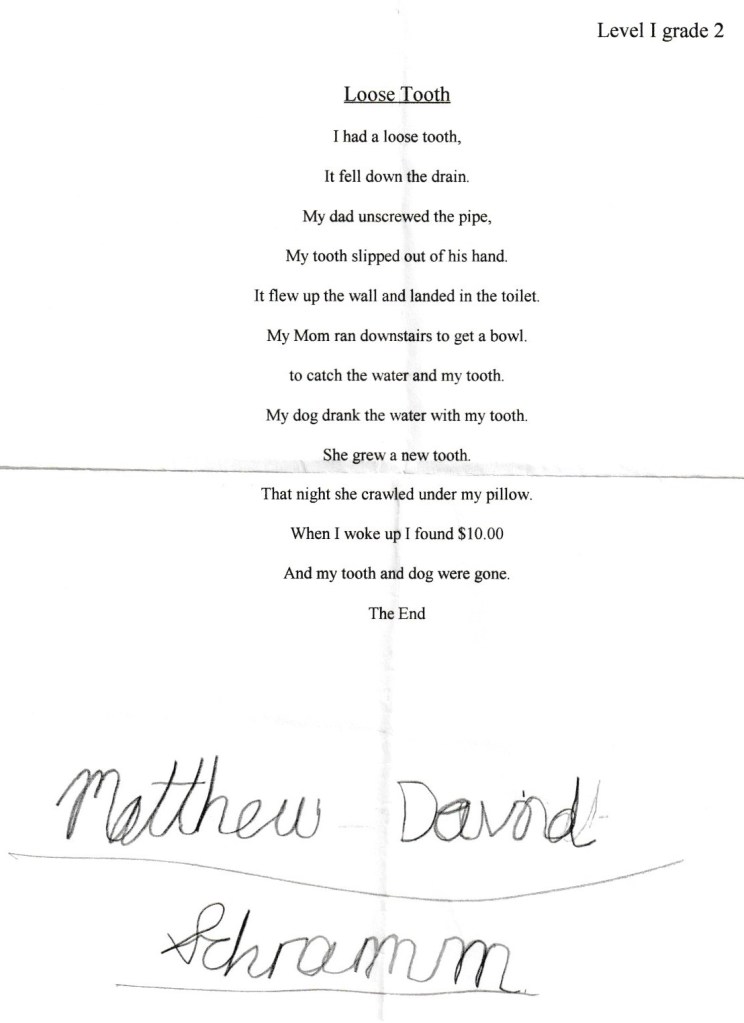
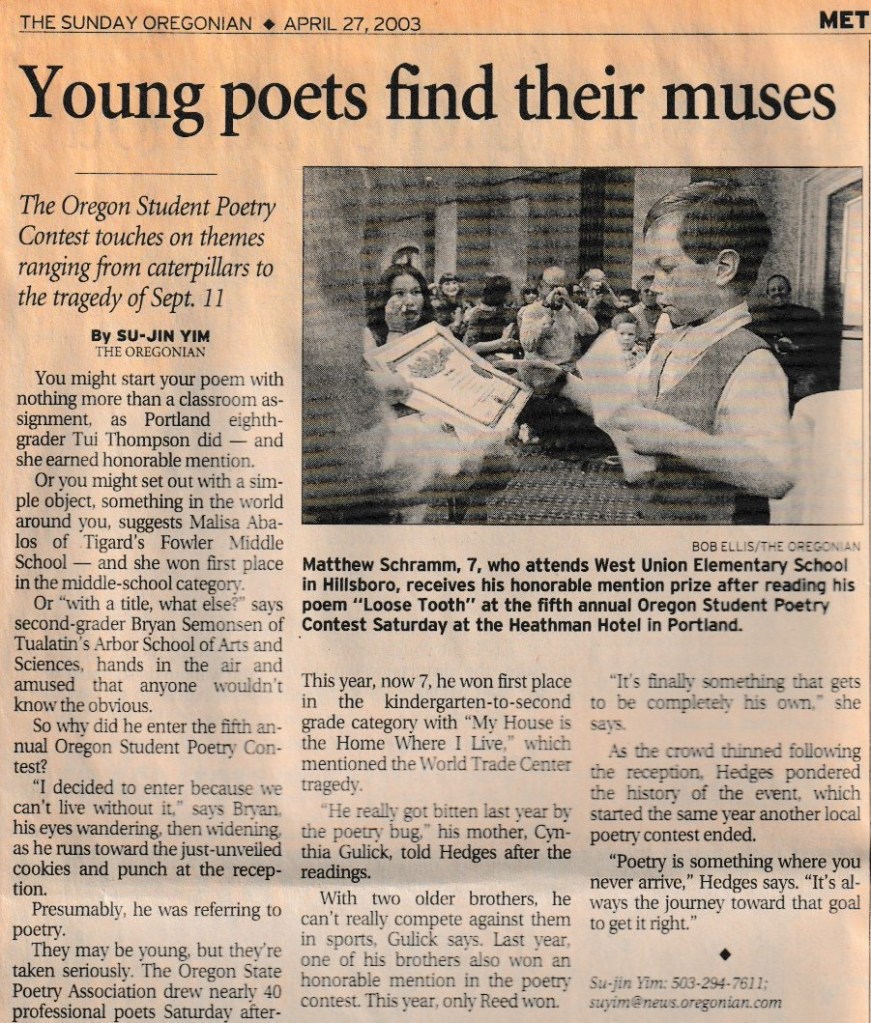
I started school young, remaining the shortest and smallest kid in my grade until puberty and high school. In Ms. Heagh-Avritt’s second-grade class, I wrote a poem. Barbara, my gramma, got me into the Oregon Student Poetry Contest, where I performed “Loose Tooth.” Won an honorable mention.
I had a pleasant time at West Union Elementary School. Learned arithmetic, cursive, reading, &c. Had a few friends: Kevin K., Joseph S., Matthew L.
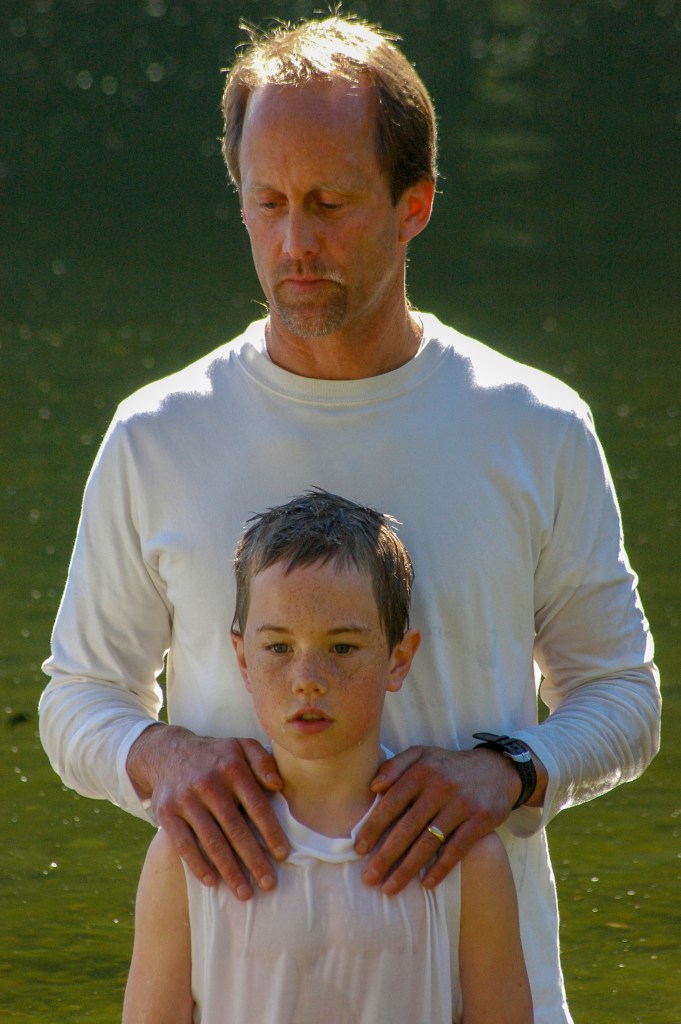
Mine was a religious household. Dad was the youth pastor at our church. Got baptized when I was ten years old.
Elbow Lake, 2006
Then it was middle school, which was less than pleasant. Full of drama and awkwardness. Mr. Thacker taught me algebra and geometry; he made it fun and entertaining. Ms. Pettis taught me history and poetry. I had a crush on a girl named Noé. I picked a flower and gave it to her, with a note.
Next, the big leagues: high school. Stopped taking piano lessons and spent all my free time playing sports. Soccer, swimming, baseball, cross country, wrestling, golf, track and field. Curtis joined our family in 2009 when I was a freshman. He was a junior, older, much bigger. We had issues in the beginning, but things became much better over time.
Christmas, 2009
Some folks from my church traveled to Tijuana, México, every summer to build a small house for a family without one. The first time I went was the summer after fifth grade. I woke up one morning with over seventy mosquito bites all over my body. Dad gave me two Benadryl, and I fell asleep on a stack of sheetrock amidst hammers, saws, and shouting. I kept going most summers from then on.
Tijuana, MX, 2010
In high school, I was mainly interested in computers, engineering, math, science, sports, and Jesus. (Only one of these things interests me, now.) I worked hard for my grades, mainly earning As and a few Bs. (One C, from senior year, when I did not try as hard because I was tired and wanted to graduate.)
Liberty High School, 2013
I spent the summer after high school playing Skyrim in my parent’s basement, much to the annoyance of my father. Video games were only a waste of time to him. I moved to Corvallis, Oregon, for undergraduate studies in Mechanical Engineering at Oregon State University. After a year of calculus and the impending doom of advanced physics, I gave up on that major. Was “undecided” for a term, then found myself in a place I had not expected: studying English literature. I had always liked reading and writing but never thought much about it as a field of study. A year later, I added a major in education to the mix, and my future was cemented. I was to become a teacher.
But first, a study-abroad in Querétaro, México, to improve my Spanish. It was the spring of 2016. Three months. Learned more of the language in that short time than I did in four years of learning in a classroom in the U.S. Took a weekend vacation in Cancún while there.
Cancún, MX, 2016
Back to America. After two more years at OSU, I earned a Bachelor of Arts in English and a Bachelor of Arts in Education. Magna Cum Laude and about $30,000 of debt at which I was to start chipping away. (If you can make college free, do it. The government decided I did not deserve help because my parents could afford to pay my way. They paid for part; the rest was on me.)
Corvallis, OR, 2018
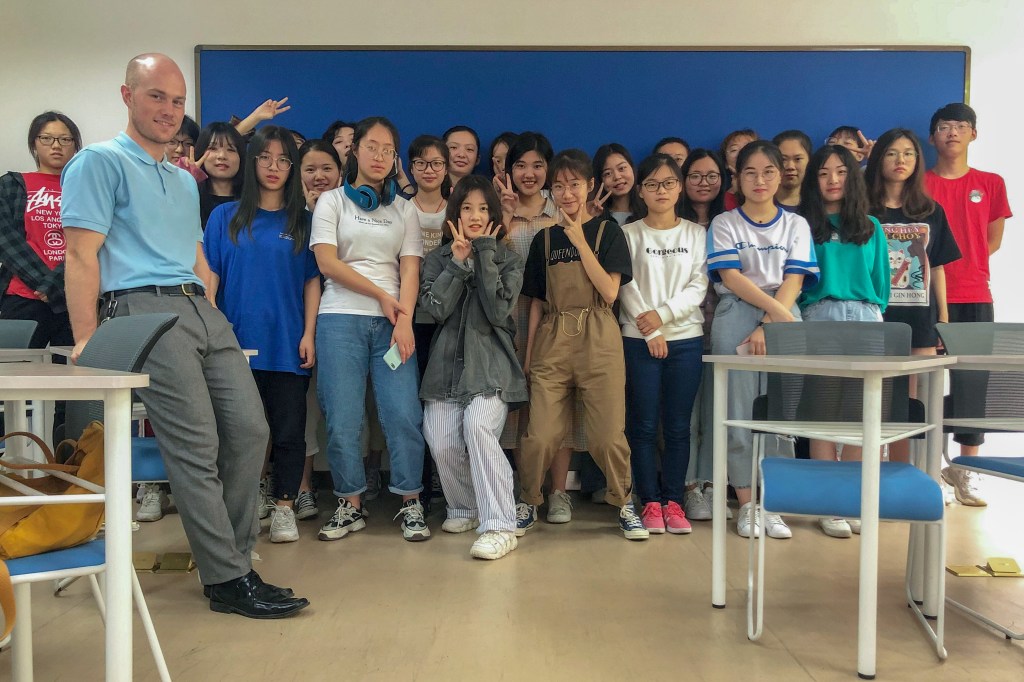
Instead of applying for public high school jobs like all my peers were doing, I took an offer from a recruiter to teach English at Shanghai Normal University Tianhua College. Spent the summer beforehand reading up on China and decompressing after five years of stress and hair loss. Then a long flight to a foreign land. It was a wild nine months.
Shanghai, 2018
Teacher and Students
China was a learning experience. I would have stayed, except that I missed my family and friends. Also, air pollution, authoritarianism, internet censorship, and a lack of religious freedom took their toll. Back to America, again. I taught Grade 7 Math and Social Studies for a year in Milwaukie, Oregon. At the tail end, schools closed because of the pandemic. My younger brother, Christopher, graduated from Luther College in Iowa with a Bachelor of Science in Nursing. He and I moved to a suburb of Seattle, Washington. He started working as a hospital nurse. I could not land a school-teaching position, so I resorted to private tutoring. My students consisted of three second-graders, four fifth-graders, one sixth-grader, two eighth-graders, and one tenth-grader. It was kind of cool, actually. I learned to value one-on-one and small group teaching, in stark contrast to having a roster of twenty or thirty students.
I felt stuck, though. Two bachelor’s degrees and a couple of years of experience in education did not seem to attract the attention of principals. I decided to go back to school. Started applying and was soon accepted into the M.A. in English program at New York University. Could not turn down an opportunity in the Big Apple. So, in August of 2021, I drove across the country in five days and moved into my new apartment in Brooklyn.
Brooklyn, 2021
The plan was to attend NYU full-time and find a part-time job to pay the bills. (Also, to take on more massive-feeling loans.) I applied to a few schools in the area, just in case. To my surprise, I was offered a full-time position at the High School for Global Citizenship to teach English Language Arts. I accepted. The rest is history in the making.
I teach. I study. This is my life—no time for anything else. But I am learning, which is all that really matters. I move forward.
EZRA: No reason. I’ll tell you; I measured. My right arm is twentyseven inches from the tip of my middle finger to the seam of my t-shirt where the sleeve was sewn to the body. My left arm is the same, so either I am a proportional human, or TJ Maxx lied to me. I am thinking the latter because, after two washes, the green stripes of this shirt bled into the white spaces around them. Another one bites the dust. Another dayshirt becomes a nightshirt. If I asked you to walk in the day with me, would you?
ISABEL: (sarcastically) That remains to be seen.
(Merriam-Webster and the Legal Information Institute, riding crops tight in their armpits, march up and down the lane. Their horses nicker, whicker, and fart.)
MERRIAM-WEBSTER: “At arm’s length” is an idiom that refers to individuals who “act independently and without one having undue influence over another.”
LEGAL INFORMATION INSTITUTE: “‘Arm’s length’ is an expression which is commonly used to refer to transactions in which two or more unrelated and unaffiliated parties agree to do business, acting independently and in their self-interest.”
SHAKESPEARE: (shrewridden) I hate my wife, allegedly.
SOCRATES: (henpecked, misogynistically) My wife, Xanthippe, is much younger than me. She is a yellow horse and an ill-tempered woman.
ARISTOTLE: (allwisest) My lover, Herpyllis, rides me like a horse. I rest on my hands and knees while she places a bit in my mouth, sits on my back, and whips my behind.
PHYLLIS: That’s not my name, brute! And you said you wanted me to ride on your back. This was all because you told Alexander to avoid me and look! how the tables have turned. Even a great philosopher like yourself is no match for a woman’s charms.
GRAVE-DIGGER: (singing) There was a gorgeous governess known ‘round town for her stubbornness. She met a pretentious poet; he composed a sloppy sonnet, trying to earn her attention with cleverness.
THE CORPSE: (disgusted) If I were not already dead, that rotten limerick would have done me in for sure.
JOHN LYLY: (speaking to Isabel) “Ah wretched wench, canst thou be so lyght of love, as to chaunge with every winde?”
ISABEL: To all you madmen, with your sickly ideas about women, allow me the final word. I keep him at arm’s length because it is my choice to do so. I tolerate him. It is easier for us to be friends than enemies, or worse, nothing at all. He buries his meaning too deep for any reader to discover it. He writes me into and out of existence. He loves me; he does not love me. I will not play his game. Let him lie still, six feet under, for all I care.
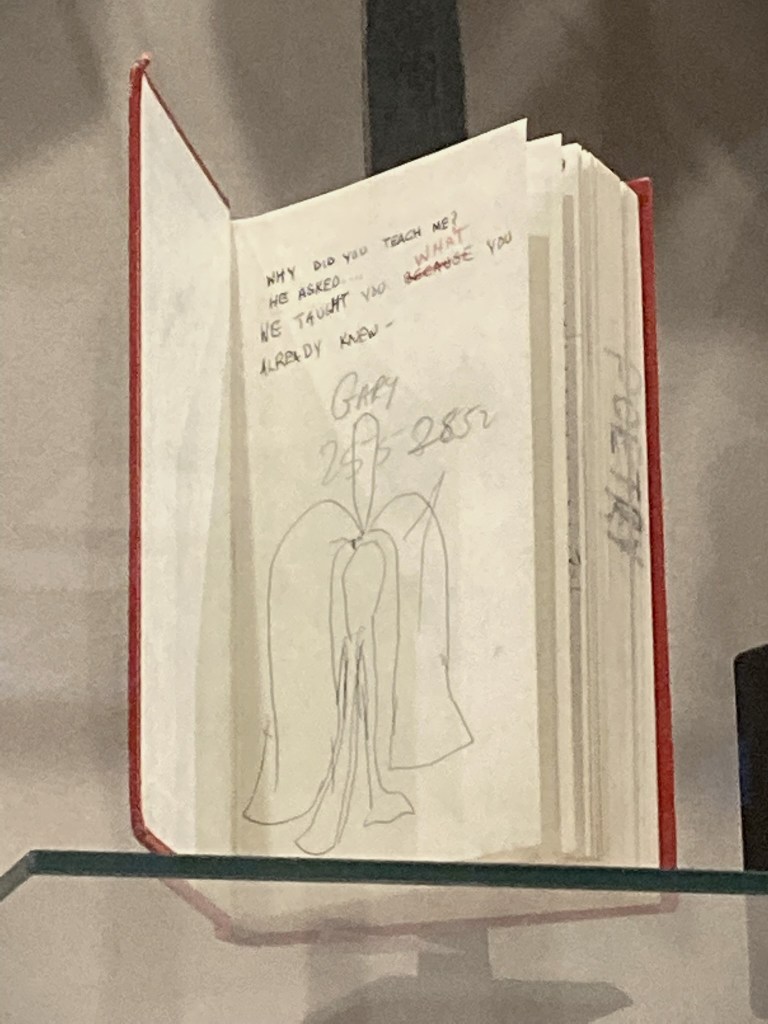
On the first page
Of a redbook
Easily overlooked
Amidst paintings and artifacts
From the artist’s personal collection
A few lines stand written
(Var står det skrivet?)
In capital letters:
WHY DID YOU TEACH ME? HE ASKED...
WE TAUGHT YOU BECAUSEWHAT YOU
ALREADY KNEW –
Talk to me,
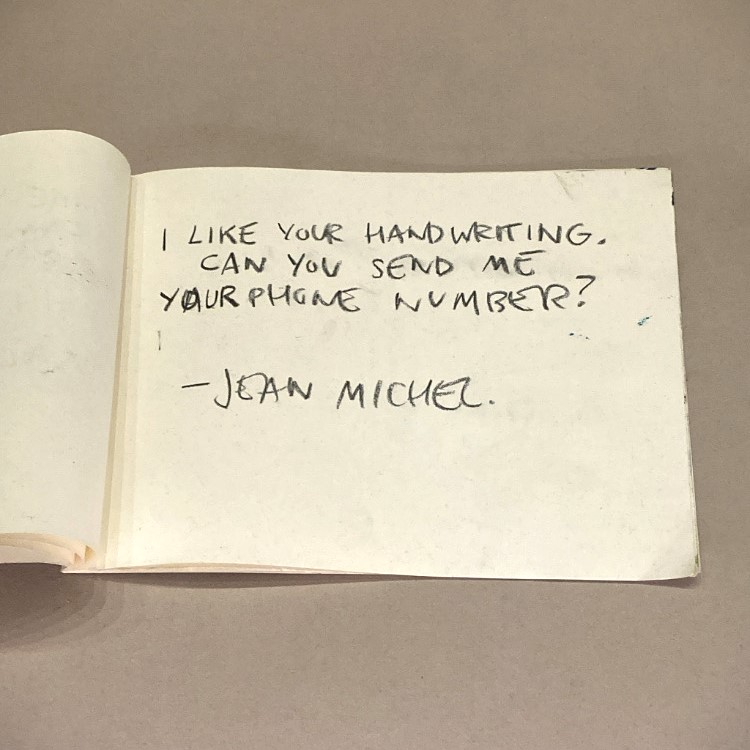
Jean-Michel
Are you “HE”?
Why does “WE”
Respond and not “I”?
First, you wrote “BECAUSE” In black ink
Then, another hand (Still your own?)
Swept in and struck it through
With red ink, writing “WHAT”
Did your English teacher
Have a bone to pick
With the question?
When she read what you wrote
Did she want to know your meaning
Or was she more interested
In you knowing hers?
How much time passed
Between black and red?
If I called Gary
Could he get me in touch
With your dear, departed soul
So you could answer my questions?
“Freshman Y--- P----- practices
In his garage at home to build enough
Confidence to break dance in public.”
A drug habit severed their souls
From their bodies
Died too young
I miss him.
Occurred 28 July 2016, afternoon (Recorded 17 August 2016, 11:49)
He turns twentyone, and the next day she takes him on a twentyone-mile day hike past Ramona Falls and up to Yocum Ridge near Reid Glacier of Mount Hood. It is glorious. He is struck dead in his tracks more than once. By what? Her and her surroundings. It feels like a positive experience, though there is one problematic scene. They are on the way back down, nearing the end of the trail, when she asks, “Do you have a best friend?”
“No, not right now. I’ve had best friends in the past, but I’m kind of on the market. I’m looking for a Jonathan to my David, y’know? Someone to knit my soul to. How about you?”
“No, I don’t either.”
They walk a little farther, and he asks, “Will you be my best friend?”
After a noticeable hesitation, she says, “Maybe, we’ll see.”
Occurred 12 August 2022, around 15:00 (Recorded 14 August 2022, morning)
The two of them are concluding their conversation. They are placing laptops into bags and cleaning up after their four-hour planning session when she says, “When have I been known to make good choices?”
He does not answer straight away. The retort in his mind needs to be edited, cut away from the script. He laughs and mutters, “Well….” He pushes the door to leave; she is behind him. “I was going to say something sassy, but all I can think of is, ‘You’re friends with me; that’s a good choice.’”
He thinks she laughs, too. Then, she replies, “That remains to be seen.”
Recorded 17 August 2022, 20:15
All he can do is write. He cannot be honest. Given the unlikely chance that he could speak his mind, what would he say?
“No shot, right?” he shouts aloud, in his bedroom, at his desk, listening to “Theme for Ernie” by Gábor Bolla. The memory dots are connected: “Maybe, we’ll see” and “That remains to be seen.” And that the date of realization is the same: 17 August. Six years later. Ducking irony. No wonder those five words have so occupied his mind. A sarcastic dagger, most likely. She did not mean anything by it. Taken literally, which seems unwise, they indicate indecision. An accidental slip of truth, perhaps. Who knows? She does. He does not.
He has written nothing much but prose recently. James Joyce has captured his attention; he is practicing for the Olympics in boat-rowing on the stream of consciousness. An open faucet. Say what comes to mind. “Men need to address skills deficits to meet healthier relationship expectations” (Matos). Alright, Mr. PsyD, show me how to use outdated statistics to make an argument about how men are emotionally immature compared to women. Gadz, the double standard! An article could never be written about how women might be less skillful in an area compared to men. That would be sexist. The doctor is touching a nerve in him. Fight or flight, baby. How is his emotional intelligence? “The problem for men is that emotional connection is the lifeblood of healthy, long-term love. Emotional connection requires all the skills that families are still not consistently teaching their young boys” (Matos). Why does he find this offensive? His own father, while not being very expressive of his emotions, taught him the importance of emotionally connecting with others. So did his mother. And his parents are living a long-term love. So, what gives? C’mon, Matos, why are you calling out men everywhere? Why paint with so broad a brush? Where is the fineness in your psychological arts? You want men (only?) to do the following:
Level up your mental health game. That means getting into some individual therapy to address your skills gap. It means valuing your own internal world and respecting your ideas enough to communicate them effectively. It means seeing intimacy, romance, and emotional connection as worthy of your time and effort. (Matos)
When Sunny smiles
It brings out the best in him
When she laughs, it is like
The world will never end
When Sunny dreams
He dreams with her
The two are determinedly un-
Conscious, blissfully aware
They are appositionally
Opposite in their person-
Alities and would be in-
Compatible if not for
The truth is he loves her
He does not love her
She is a series of con-
Tradictory statements
With a tight waist
Facing east while
He faces west
They pass in the night
And wave hello in the
Morning at work
Teaching teen-
Agers to read
When Sunny is silent
It allows him a unique
Opportunity to imagine
What she thinks about
She does not think
About him, thankfully
Whatever feelings
He has are not re-
Ciprocated, she is
Sericated, queenly
He is plebian and does
Not know how to dress
Himself, having never
Determined a suitable
Clothing style
Nothing ever fits
Nothing is ever easy
It all takes so much
Fucking work but
The Sunnys of the earth
Are covered with pearl-
Like drops of dew
And tears, waiting
For themselves to uncurl
From being world’d too much
A poem is a made thing
Art should encourage man-
Nerism; her stylish style
Emphasizes artifice over
Realistic depiction
We tread in the foot-
Steps of Old Masters
And paint nudes in comp-
Licated and contrived poses
Have you got acid
Color in your cheeks?
She breaks with unity
He retains it
She is dynamic
He never moves
The autopsy ends and
The moon coroner packs
Away his saccharine utensils
As Sunny rises.
Yes because she never did a thing like that before as to ask him about his day when he didnt come home until late after work one night it was a full day of doing nothing much because it is summer and he is on vacation and has little to do but complain to himself about how alone his hands are and how together it seems other peoples hands are if only he knew what she was thinking about him if only he could go to sleep without his brain running in circles like a headless chicken do they really do that hes never seen a headless chicken but in the movies its a certain way you see people falling madly in an out of love and a different she cannot take him seriously because he was silent and didnt text her for a couple of weeks sorry yes she is right he should have said something he should have told her she was beautiful and didnt need correction and didnt need to paint her face for him who was jobless and handless when he moved to the big city now he has a job that he has to start thinking about again he will go back for another year and there is nothing much to say or do about the matter he wishes he never had to say anything at all that his mouth was just another organ playing a deep note while his hands did all the work what if people didnt need to speak and they could just feel each others feelings and know what it means to be a man and what it means to be a woman and what it means to be everything people think is in between or other or who is he to wonder about identities that are not his own he has a dokos in his own eye and that beam of timber or log or plank or whatever is all he thinks about his old friends used to point out the clenching of his jaw and the narrowing of his eyes and the face of judgement he constantly wore and still wears too often he wants to be less that way so she will want him she is not she in fact at all or something or other she is a figment of pleasure and imagination the real she is something much stranger and more unfathomable if only a few things were different theres always those one or two items about a person that convince him to lose interest if ever there was interest in the first place with this conjured she there is everything right and everything wrong at the same time dont ask him to explain he couldnt if he tried and these thoughts are not an explanation or an analysis or anything academic they are just whats inside and outside in conflict with each other they are representative of an agon between his brain and his heart who wins who always wins with him the brain of course he is just too damn guarded and unwilling to take big risks because he loves and hates conflict at the same time she cares for you and you have feelings for her dont overthink it surrender to spontaneous honesty there is nothing more beautiful in human relationships seize the night seize your chance enjoy one another thats it have fun says Gaunter O’Dimm its a proper noun so just this once an apostrophe will be used by evil incarnate or Satan himself or maybe also God it is hard to say this mans identity because the author leaves it open to interpretation in order to read you have to blur your eyes a little and pretend there are punctuations in your soul that make things formal and acceptable to the public who like to put a stamp on your forehead or burn a brand on your arse or tattoo a number on your wrist so they think they know precisely who and what you are what if he was not of planet earth at all but someone from the far future or problematic past are we progressing are we moving toward utopia which looks like equality for everyone in all places and times even the deceased are being disturbed in their graves let them lie let them lie let them hold onto their groupthink and unconscious universal connection to something that no one can prove is real science has limits so does religion what does he believe is real can he even know things where does the regime begin and end he is significant he opens his mouth to shout but the words dont come out its not over till its over and love is like a rattlesnake warning before it bites she is his antivenom she is the antidote for his handlessness and lonesomeness she is everything he wants her to be except she is not she just get over her already and move on you two are incompatible and it wouldnt work in a thousand years and even if you were the last two people on the planet because she likes women and he likes women too and he finds some men attractive but not like that no never like that because those thoughts are disallowed his aunt jokingly suspected once but she was just searching for something to knock her brother off his high horse and how high he sits with good reason he is a good man but these days it is not him and he is not he and any resemblance of the third-person narrators in the previous and following lines to the author is purely yes and yes he said he will yes her no and she will no his yes and the two will maybe into foreverland where ignorance is the best way the only way for them to survive and what if and what if and what if and what if and what if and what if continues and continues and continues like a canon booming once then echoing in the ears of those who arent around because if hes lucky like two or three people will have made it this far without giving up because its hard reading and rereading and getting lost and having to start all over again no one likes to start over again we all wish once was enough but he gets lost in the sauce singing yes and yes to himself duh nuh nuh nuuhhh duh nuh nuh nuh nuuhh nuh nuh dunuhnuhnuh have you got color in your cheeks dear where did it begin and when did you first know it wasnt him but instead another who you could care for when did the bell jar close over her head and begin to suffocate steal kill destroy her will to live why did she stick her dome in an oven and could the doctor have stopped it from happening and even if he could have who is to say she wouldnt just try again she was unfaithful to a lover once and fifteen tracks in finally gets to the point where her darkest truth of all is revealed he tries to save her and she tries to escape him because she doesnt need saving and he isnt the messiah he is just a negative number moving farther and farther away from zero the middle doesnt exist anymore if it ever did it was just two poles north and south with a beam of light cutting through stale air moving back and forth between chorus and bridge and chorus and bridge until the authors of the world write new verses like yes and yes please feed him with your old lyrics revised into new forms crawl into bed with him and hold him until he sleeps soundly in a nine foot by eleven foot New York apartment for which he pays what feels like an inordinate amount of money when will the owners die and the workers get their just deserts because poetic justice isnt real the bad guys sometimes win with a snap of their fingers because power isnt ours it belongs to the few monarchs and dictators and presidents and princes of the world while the rest of us get told to work hard and you will be okay thats the ticket work hard and you will get what you deserve death is what he deserves and she deserves and they deserve and we deserve because no heart is free of hamartia until it recognizes the beauty and true love of Jesus Christ or thats how the story goes it is a true story so it has errors and imaginations to cover the gaps of lost manuscripts and unrecovered artifacts that were eaten away by almighty Time after time and his yes to her no and her yes to his no are not the same after all.
The tension of translation is between readability and accuracy. Hard to achieve both. I deal with texts in translation more often than the average person, I would think. This last school year, I taught Kafka’s The Metamorphosis, which is originally in German. Gregor Samsa wakes up as an “ungeheueren Ungeziefer,” which is usually translated into something like “horrible vermin.” Accurate, mostly, but not very descriptive. Granted, it is a complex phrase to parse literally. Ungeheuren (adj.) is a size word, like “enormous,” “immense,” “tremendous,” or “monstrous,” and it appears to be a word less preferred than others when describing a large something. Ungeziefer (n.) does mean “vermin” but also refers to “pests” and “insects.” If one searches the word on German Google Images, one finds an array of small, six-legged insects. In English, “vermin” also signifies bigger creatures like rats, squirrels, or wild rabbits. Especially on the farm, where anything that raids or infests might be called “varmint” by an angry Appalachian man or woman. Gregor Samsa is undoubtedly an insect, given later descriptions of his buggy form. He is often pictured as a cockroach, though there is little textual evidence to suggest this.
Another text in translation: the Bible. Humph! Yes, I know. Even the word “Bible” might conjure bad images in one’s mind. Might make one think of all the partisan religiosity wrecking the country and our churches. Might make one think of old, white men with too much power. Evangelicals voted for Trump, and supposedly, Evangelicals read the Bible. I am not so sure, and I am not one of them. Please, suspend your judgment for a moment and bear with me as you would a friend. Maybe what follows is for you and maybe not. Mostly, it is for me. I need to remember the past and write it down. I need to decide what to do about my present and who I want to become.
Between the end of 2015 and 24 May 2018, I completed a full reading of Christianity’s sacred text. Filled at least eight journals along the way. It was a scenic route with much stopping and starting. Then, I fell off of the habit of daily reading and journaling. I do not remember why. In any case, most of my efforts after that point became sporadic, sometimes nonexistent. I moved to Shanghai, China. Was a part of a Southern Baptist missionary plant while I was there (options were limited, chose not to become a member). Spent more time reading The Lord of the Rings—the only book I brought with me—than I did reading scripture.
Returning home, I landed in Milwaukie, OR, to teach middle school math and social studies. Attended Grace City Church in Portland. The following summer, on 2 July 2020, I moved to Kirkland, WA, with my brother. A good year. He is the best roommate I have ever had. He was much busier than I, who was getting through a pandemic by private tutoring a range of ages in a range of subjects. On 27 October 2020, I finished reading the Gospel of Luke. From 4 December 2020 to sometime in the spring of 2021, Jimmy, Junil, and I read and discussed the Acts of the Apostles. Did not take much or any notes by the looks of it; I can only find four journal entries with an “Acts” header. I remember wanting to write less and listen more. Reach Church was wrapping up its tenure in the Gospel of John during this time, and I have some sermon notes. Sunday service nearly became the only time I would look at a Bible.
Then, on 11 August 2021, I started a cross-country road trip of five days, arriving in Brooklyn, NY, on the 15th. Hit the ground running. Had to find a job ASAP. Was planning on attending NYU full-time, but that changed when I was offered a full-time teaching position at the High School for Global Citizenship in Crown Heights. NYU became a part-time venture, which is about all I could manage with the demands of public-school teaching in a new environment like this one. I thought about church. Do I even want to go? What will it be like to meet in person after all this time? I figured it could not hurt and attended at least one service at Every Nation Church NYC before settling at Bridge Church here in Brooklyn. Pastor James Roberson III et al. did the book of Romans. It is a good place, full of good people. Mostly young and single, like myself, though that does not make it any easier to meet people and make friends.
Now, being free of work and school for the summer vacation, I finally have time to sit and breathe. I do not know what to do. Should I start my days reading scripture and journaling like I used to? What would be the point? Why go back to this library of religious books after such a long hiatus? I have not had what one might call a “daily devotion” (Christianese—if you know, you know) since finishing Luke in October 2020. I fell off. But if what one means by “daily devotion” is just “me time with the Word,” I do not think this alone makes for a good imitation of Christ. And how much of it can I blame on the pandemic? I need a scapegoat. I need a reason to explain this spiritual dry spell. There is an app I found called “Literal Word.” It has a “Reader” mode which removes section headings, verse numbers, footnotes, &c. Uses the New American Standard Bible for its “word-for-word instead of a thought-for-thought translation method,” which “allows readers to make more interpretive decisions on their own.” I like the sound of that. The NASB is accurate but not readable.
A couple of Band-Aid sentences to avoid the problem. “Lullabies and alibis/ The book don’t end with Malachi.” Thanks, Chance. I should take a chance. “If someone wants to sell their soul for a bike light, they can have it.” An inside joke no one will understand but my brother. Forgive yourself, Matthew. Do not be so hard on your poor soul. You are not a punching bag. I struggle with that phrase, “forgive yourself.” I am one, not two, not three. “Do I contradict myself?/ Very well then I contradict myself,/ (I am large, I contain multitudes.)” If I could forgive myself, I would not need Jesus. Of course, it is a figure of speech. Do not be so literal, child. I understand the sentiment: “Release the guilt and punishment you feel you deserve for the mistake you made.” I only want better words. Sydney said something like, “You’re more multitudinous than you think.” Is she describing me in particular, or is this representative of a personal philosophy she has about all people?
I am going to try… no, there is no try. I am going to read the Gospel of Mark because it was written first and because I need to relearn how to make Jesus beautiful, both to myself and to the small number of people in my life. Evangelism without words. Immerse myself in the alleged truth and beauty of Christ so I might become more like him. And I want to read literarily. (Con cuidado, I said “literarily,” not “literally.”) I want to put on a lens and ask questions about the text that are not being asked in church. The Bible is a work of art and should be treated as such. Many church leaders and people I have met seem to read scripture as Plato would have, with a mimetic, “art imitates life” outlook. We think, like Plato, that if art does not teach morality and ethics, then it is of no substantial use. Nondidactic readings of scripture are antipulpitic.
In my post-secondary education, I have encountered very few (or no) scholars and university faculty who overtly read literature in search of some life lesson. None ask, “What is the moral of the story?” But preachers do it all the time. They might not use this language, but they will have three alliterative points so their childish, illiterate audiences can feel good about going into their weeks with a life application in their pocket. Slow down, sir. We can read, too. I know you can. It is just one reason why I am somewhat (read: absolutely) disillusioned about Sunday service. Treat me like an adult, please. I, for one, no longer need milk to drink—give us solid food! The Bible is not children’s literature, and I graduated from Sunday school long ago. Make me think hard to understand what you are saying. Make me work to understand your parables. Do my eyes see? Do my ears hear? Has it been granted to me to know the mysteries of the kingdom of heaven?
An alternative to Plato can be found in his student and colleague at the Academy in Athens, the man-myth-legend, also known as the Philosopher—give me an A-R-I-S-T-O-T-L-E! While still holding to a mimetic aesthetic, Aristotle departed from his teacher in some notable ways. What follows is my interpretation and understanding of Aristotelian philosophy regarding the production and criticism of artistic works. His esoteric treatise, Poetics, “takes as its topic the making of a work of art” (Richter 39). Aristotle nearly dismisses Plato’s idealism, trading it in for a realistic or literal discourse on what makes literature effective or ineffective. Poetry and drama are a means to an end. A poem is an object, a made thing, so we can focus on its form by asking questions about shape, materials, composition, and purpose. Much later, Aristotle experienced metempsychosis in the bodies of Russian Formalists, New Critics, and Neo-Aristotelians. While traditional formalism has been largely vanquished by postmodern criticism, some of its tenants more than linger in secondary education. Form follows function; all we need is “the text itself.” Though the dinosaurs are dead, we can thank them for their invention of “close reading” and for teaching us to use “concrete, specific examples from the text itself to validate our interpretations” (Tyson 117). Shklovsky, Brooks, and Booth were assassinated by Iser, Rosenblatt, Saussure, Lévi-Strauss, Chomsky, Derrida, Foucault, Greenblatt, and most of the contemporary feminists, queer theorists, and critical race theorists. (It’s okay, they had it coming to them.)
What questions might a Neo-Aristotelian ask of a text? I am thinking, particularly, of R. S. Crane and his successor in the Chicago School of Literary Criticism, Wayne C. Booth. Though I would not consider myself a disciple of their theories, I appreciate their commitment to pluralism, which was one of their main disagreements with the New Critics. According to Richter, Booth’s 1970 lecture, “Pluralism and Its Rivals,” is “an affirmation of Crane’s vision of critical systems as a collection of instruments, or tools, each with areas of blindness and insight” (712). We who study and teach literature owe more than we would like to a man like Booth. He was born on 22 February 1921 in Utah to Mormon parents. He was a member of the LDS church throughout his life, yet he was committed to pluralism and engaged in a lifelong battle with religious dogma. He coined the phrases “implied author” and “unreliable narrator.”
Near the end of his life, Sunstone, a Mormon periodical, published an article of his titled “Confessions of an Aging, Hypocritical Ex-Missionary,” in which Booth details the progression of his spiritual journey from religious fundamentalist to metaphorical Mormon. Imagining a dialogue with his younger self, he asks, “Isn’t our real assignment, as we approach the new millennium, to discover what we share and then decide, probing our differences, just what can be cast aside?” Then, he mentions a phrase of his, “rhetorology,” by which he means “not rhetorical persuasion but rather a systematic, ecumenical probing of the essentials shared by rival rhetorics in any dispute—whether about religion or about other important matters.” His goal is to bring himself together, to unite his various past and present selves, along with members of the LDS community who might disagree with his (un)orthodoxy. A final quote: “There are obviously no scientific or strictly logical proofs for the importance of ecumenical, pluralistic probing. But I can find no good reasons to doubt its service to genuine religion.” Those phrases, “pluralistic probing” and “genuine religion,” appeal to me.
A pair of essays by Booth, both delivered as lectures to students at the University of Chicago: “How Not to Use Aristotle: The Poetics” (1963) and “How to Use Aristotle” (1968). The purpose of the first is “using the Poetics without abusing it” (105) to rebut the way scholars have reduced and misinterpreted the Philosopher and his text. I doubt you are interested. If you want to read it, see “Works Cited.” If not, here is the quote I was hoping to find: “The question that was constantly on Aristotle’s lips was, Why? What is the function? What is the purpose? The end, the final cause, is everything. All right, then. What we should do is ask of a literary work, Does it hit me hard?” (107). Aristotelian questions are all I wanted. Thank you, next.
Time and place: winter of 1968 at UChicago. Audience: college freshman taking “Liberal Arts I.” It was a turbulent time at this academy and in the culture. Radical leftist students and the right-wing bureaucratic establishment were at war. (What else is new?) Both factions failed to see their opponents as reasonable human beings, and Booth stands in the middle, attempting to bring these disparate communities together through the elevation of proper rhetoric. The situation is dangerously absurd. Let us learn to love a little irony. Earlier that year, sections of Chicago had been reduced to rubble in the riots that followed the assassination of Martin Luther King, Jr. From 23 to 28 August, major protests against the Vietnam War occurred during the Democratic National Convention. (Think Chicago Seven.) Then, on 13 November 1968, a professor of sociology at UChicago named Marlene Dixon crossed an invisible boundary by joining student protestors during the inauguration of a new university president. What penalty? The sociology department decided not to renew her appointment. Then, on 30 January 1969, over 400 students sat-in at the administration building and refused to budge for two weeks. They perceived Dixon’s removal to be an injustice: she was being punished for her openly Marxist and feminist politics. O! how the pendulum has swung! One would be hard-pressed today to find a liberal arts professor at a school like mine who does not at least have sympathy for Marxists and feminists.
In a world of “us versus them,” Booth strives for consensus. In the second lecture-essay, he gives a sort of follow-up to the warning he had delivered five years prior. Booth begins by considering a lecture by one “Mr. Denneny” on Søren Kierkegaard (I could not find the source or its container, my apologies), suggesting it is “radically dialectical in method” (118). Then, he puts this method into question, showing how those who view the world in terms of thesis and counter-thesis invariably tend to oversimplify lived experience. We who do this generate abstractions that disagree with “the concrete reality of persons, feelings, facts” (120). Furthermore, he condemns the foolishness of those who commit “what Sartre calls the greatest sin”: turning real people into abstractions (121). (Aside: herein lies the foolishness of “pro-choice” and “pro-life”; both sides turn their opponents into disembodied ideas rather the divine image-bearers.)
Instead of “being forced either to struggle on to find the right set [of polarities] or to become relativists” (122), Booth urges his listeners to become “‘existentialists’ at least in the sense of attempting to deal with the world’s problems quite literally for what they are” (123). He shifts his attention to Aristotle now that the problem has been constructed. How would Aristotle have read “Clay” from Joyce’s Dubliners? As it so happens, I read this story for my summer course at NYU. It is about a middle-aged unmarried woman named Maria who works at a laundry in Dublin. She is like a second mother to Joe Donnelly, whom she had cared for when he was a boy. Joe, who is now grown and married, invites Maria to their home for a Hallow Eve party. Two next-door girls put together some games for the group to play. One, a game of divination, sees each of its players blindfolded while they search for objects resting in saucers on a table. According to Terence Brown, who made the notes for my copy of Dubliners, the four objects used in this version of the game are as follows: “A prayer book which presages entry to a convent or monastery, the ring which promises marriage, water which assures continued life and clay which indicates death before too long” (280). Maria is led up to the table by the children and lays her hand upon one of the saucers, where she “felt a soft wet substance with her fingers and was surprised that nobody spoke or took off her bandage” (Joyce 101). Unknowingly, Maria picks the clay. Then, she realizes “it was wrong that time” (Joyce 101) and picks again, landing on the prayer book. So, instead of marriage, it is death or the convent. After the game, Maria sings I Dreamt that I Dwelt, an aria from Balfe’s opera The Bohemian Girl, and Joe is moved to tears over his friend’s suffering.
In his Aristotelian analysis of “Clay,” Booth suggests readers who read this way will “come to know it as something unique—even though it shares qualities with many other works” (125). Moreover, we will “come to know the works [we] love for what they are, and not what they can do as illustrations for your pet ideas or as evidence for your political party or church or for your lecture on Aristotle” (125). Finally, we will “know how it works, which is to know why its parts are as they are in relation to the effect of the whole” (125). Now, some questions Aristotle might ask of a text to judge the quality of the text as well or poorly made:
What is its shape?
What is its style?
In what manner is it composed?
For what effect is it made?
Does the story achieve a certain standard of beauty?
What makes it great (or not)?
Booth characterizes Aristotle as saying, “The poet is poet primarily through his imitative power, and he should intrude into his stories no more than is ‘necessary’” (127). (What would the Philosopher have said about autofiction? Would he have criticized authors who create autobiographical illusions by writing themselves into their own imagined realities?) Aristotelian questions are all I wanted. Here is an extended passage from Booth’s second essay. I retain it in full because I consider it “well-made” and worth a complete reading:
There are many questions that Aristotle’s approach will not answer: questions about the spirit of tragedy through the ages, questions about how to rise from despair to faith, questions about how to use art to attack your enemies, questions about which modes of art should be given to children at which ages to educate their souls—these and many others are either ignored by him or are treated briefly in other contexts. To anyone who does not care about what makes a great story great, what he says must seem boring and irrelevant. To anyone who prefers to dwell steadily on the level of abstract ideas, debating forever questions like whether the spirit of tragedy is dead in our time, or whether the novel is dead, or whether the new media have killed the message, his stuff will seem initially pedestrian and literal-minded. But, you know, there is no better cure for despair than rousing oneself and joining a great artist in his particular creative acts; there is no better proof of man’s nobility than seeing a bit of it really work in a great piece of art; there is no more satisfactory proof of the existence of the good, the true, and the beautiful, than experiencing their fusion in the unique, particular achievement of a story like “Clay.” (128-29)
A cure for despair is what initiated this whole essay. What are we doing? It is why I am here. I need to be lifted, to lift myself. I need to join great artists in their art.
Booth ends his lecture with an irony, probably on purpose. He wants his listeners to “use moderation in their choice of question,” to “solve solvable problems” rather than “juggle abstractions for purposes of warfare or evangelism,” and to focus on “the concrete things of this world” which can be “of immeasurable interest and reward” (129). Sounds nice. The literalist in me would love to lean into the beauty and greatness of texts. Unfortunately, Booth falls into his own trap by creating yet another dialectic, this time between abstraction and concretization. It is Plato versus Aristotle, redux. (I am being crudely reductionist.)
I imagine Booth saying, in his voice and mine, “We live in a credulous age; everyone is too ready to believe what they want to believe. Let us learn to become skeptics in the ancient sense. We need to investigate the text and suspend our judgment. Knowledge cannot be found. A life without belief is a life well lived. This world subsists on despair, but there is art, ripe and ready for eating.” Do not put words in my mouth. My tongue says what it says. I only want better words. Give me Plato on a ceramic plate and Aristotle, decanted from a crystalline carafe. Show me the idea of a woman, then show me who and what she really is. Wipe the paint off her face. I do not think I like where this is going. “The text itself” sounds too much like “Sola Scriptura,” one of the five Solae of reformed theology. Is the Bible the single “infallible” source of authority for my faith in Christ? I do not use these words—“infallible,” “inerrant,” or “inspired.” Instead, I would be inclined to suggest that the text we call “God’s word” is true and trustworthy. No farther. If I must play the part of an unreformed heretic, bite me.
Disintermediation: cut out the middleman. When I pick up a book, how much work takes place in the final construction of meaning? Is meaning-making the means or the ends of the process? In this process, who are the middlemen that can be cut out? “And if your eye is causing you to sin, throw it away” (NASB, Mark 9.47). The Greek word translated here as “throw” is ἔκβαλε (1544. ekballo, v.), which Strong indexes as “bring forth, cast forth, drive out, expel” and Thayer denotes as “with the included notion of more or less violence; to draw out with force, tear out.” The author of Matthew uses a different Greek verb: ἔξελε (1807. exaireó) in 5.29 (trans. “tear”) and 18.9 (trans. “pluck”).
Peter Barry defines narratology as “the study of how narratives make meaning” (214). It is a “branch of structuralism, but it has achieved a certain independence from its parent” (214). Of all the literary theories I have encountered, narratology remains my favorite, mainly because it can readily be adapted into lessons for the high school English classroom. We teach Freytag’s Plot Pyramid and Campbell’s “The Hero’s Journey”—both are ways of thinking about stories en masse in an attempt to answer the age-old question: what do all narratives have in common? “All stories have events and characters,” I have told my students. It starts with exposition, then rising action, leading to a climax, and falling action, with a final resolution/conclusion/dénouement (however you like to call the ending of a story). It is as good a place as any to start one’s understanding of how texts behave when one forces them into a neat, little box. But of course! This is not the only way. One needs only to read Sorrentino’s Under the Shadow and Abish’s How German Is It in an undergraduate course on postmodern fiction and encounter novels that can hardly be called novels because they break all the “rules” one had in one’s mind about how a story should be told.
Aristotle cannot be said to have set rules for the making of a good Greek tragedy. No, his goal seems more to describe than prescribe. (Scratch all that; it is what I wish were true.) To the Philosopher, a well-constructed Tragedy is a whole thing made up of three parts: “beginning, middle, and end” (trans. Bywater 233). Qualitatively, Tragedies include “Spectacle, Character, Fable, Diction, Melody, and Thought” (231). Quantitatively, they have a “Prologue, Episode, Exode, and a choral portion, distinguished into Parode and Stasimon” (237). But I am less interested in these features and more in Aristotle’s slicing up of Plot, which is “the first essential, the life and soul, so to speak, of Tragedy” (232). Bywater translates Aristotle’s three elements of Plot as “Peripety,” “Discovery,” and “Suffering” (Ch. XI, 236-37). Peripety is περιπέτεια (peripeteia, n. fem.), meaning “turning right about, reversal of the normal order; esp. sudden change of condition or fortune” (LSJ). Discovery is ἀναγνώρισις (anagnorisis, n. fem.), meaning “recognition, as leading to the dénouement” (LSJ). Suffering is πάθος (pathos, n. neut.), meaning, well, a lot of things. Pathos is a chameleon word, ever-changing depending on its context. Strictly speaking, it is “that which happens to a person or thing” (LSJ). The complete sentence in question is as follows: “A third part is Suffering; which we may define as an action of a destructive or painful nature, such as murders on the stage, tortures, woundings, and the like” (237, emphasis added). In Rhetoric, Aristotle uses pathos like this: “Persuasion may come through the hearers, when the speech stirs their emotions” (trans. Roberts 25, emphasis added). Here, pathos is the compatriot of ethos and logos; the three form a trimodal pyramid of persuasion. The goal of the rhetor utilizing pathos is to excite passion in their listener so as to convince them to “wake up and feel the world,” as it were.
To clarify the connection between the seemingly disparate connotations of pathos, we may consider a keyword found in Aristotle’s definition of Tragedy:
A tragedy, then, is the imitation of an action that is serious and also, as having magnitude, complete in itself; in language with pleasurable accessories, each kind brought in separately in the parts of the work; in a dramatic, not in a narrative form; with incidents arousing pity and fear, wherewith to accomplish its catharsis of such emotions. (230)
You have heard it before: “Music is cathartic for me; it helps me release my emotions.” Sure, but that is not what Aristotle means. No, it is so much more hardcore. Broadly, κάθαρσις (katharsis, n. fem.) is “cleansing from guilt or defilement, purification” (LSJ). Aristotle appears to mean it in more of a medical sense, as in “clearing off of morbid humours, etc., evacuation, whether natural or by the use of medicines” (LSJ). (“Humours” refers to the body’s four main fluids: blood, phlegm, yellow bile, and black bile. Thank you, germ theory, for replacing this absolute nonsense. Did those ancient and medieval physicians have any idea what they were doing?) Perhaps this will make sense: katharsis is the body’s natural reaction to seeing pathos (suffering or calamity) on a stage; a good Tragedy induces pity and fear in the subject, who then purges these strong emotions from their body as metaphorical solids and fluids. Gross. How can I not make this sound like defecation?
We are nearing the end. Aristotle also describes his ideal tragic hero as an “intermediate kind of personage, a man not preeminently virtuous and just, whose misfortune, however, is brought upon him not by vice and depravity but by some error of judgement” (238, emphasis added). This “error” is sometimes translated instead as “flaw”; it is the Greek word ἁμαρτία (hamartia, n. fem.), meaning “a failure, fault” (LSJ). In scripture, we have similar terms, which I will present in their verb forms. The first is Hebrew: חָטָא (2398. chata), which means “to miss, go wrong, sin” (Strong). The second is Greek: ἁμαρτάνω (264. hamartanó), which means, similarly, “to miss the mark, do wrong, sin” (Strong). (Notably, Homer and Aeschylus use hamartia to describe an archer missing their target.) In relation to the study of narrative, these words are helpful in a dialogue about poetic justice. Virtue is rewarded, and vice is punished. The characters get what they deserve. (I am running out of steam, so I will put a pin in this for future study: Is hamartia a “flaw” or “error”? Does it occur in the intellectual thought life of a character, or is it more of a moral failing in the soul of a character? What space do hamartia and hubris share?)
The fuel tank is on “E” and petrol is damn expensive these days. I have my questions; I have what I came here for. The problem, now: can I read Mark with an Aristotelian lens? Of course, the gospels do not appear to operate like Greek tragedies. (Or do they?) For one thing, if Christ is the tragic hero of the story, then he is one supposedly without hamartia and hubris. That said, there are plenty of examples of recognition, reversal, and suffering. Furthermore, one can consider the artistry of Jesus’s miracles and parables. Does the author tell a great story? Can we join him in his particular creative act and be pulled out of despair and into faith?
Allow me to speak precisely. I find delight and pleasure in your presence. I desire you. I am blind, yet I have insight. In Ulysses, Stephen Dedalus poses a riddle to his students: “The cock crew,/ The sky was blue:/ The bells in heaven/ Were striking eleven./ ‘Tis time for this poor soul/ To go to heaven” (Joyce 80). His answer: “The fox burying his grandmother under a hollybush” (Joyce 80). A joke at the expense of riddles. Unanswerable unless the answer is already known. “What have I got in my pocket?” Hands? Knife? String, or nothing? You cheated, Bilbo. So did you, Stephen. And you got what you deserve. What do I deserve? Death and life and life and death. I want to live alone forever. I do not want to live alone forever. Show me the idea of a woman, then show me who and what she really is. Wipe the paint off her face.
——— “Confessions of an Aging, Hypocritical Ex-Missionary.” Sunstone, March-April 1998, Vol. 21:1, Issue 109, p. 25-36, www.lds-mormon.com/booth-shtml.
Joyce, James. Dubliners. Introduction and Notes by Terrance Brown, Penguin Books, 1993.
——— Ulysses. Edited by Hans Walter Gabler. Vintage Books, 1986.
Liddell, Henry George; Robert Scott; Henry Stuart Jones. A Greek-English Lexicon. Also known as the “LSJ.” Perseus Digital Library, www.perseus.tufts.edu/hopper/morph.